
Pedal power has got me so far. I love my trusty commuter push bike. I take pride in the muscles it builds.
But with my five-year-old shooting upwards at a rate of knots, I just can’t carry her on my bike anymore. That means I can’t go by bike to all the places I’d like to. Hilly routes in general are daunting. Plus, I have a dream of quaxing my entire weekly shop home by bike – something my push bike just isn’t the right vehicle for.
What is quaxing?
In January 2015, a local councillor in Auckland, New Zealand, Dick Quax tweeted:
“No one in the entire Western world uses the train for their shopping trips…the very idea that people lug home their supermarket shopping on the train is fanciful.”
People responded with pictures of themselves doing their shopping by non-car means using the hashtag #quaxing.
The term was defined on blogs and tweets as “Quax, [verb; past: quaxed, present: quaxing] — to shop, in the western world, by means of walking, cycling or public transit.”
My e-cargo bike knowledge gap
An e-cargo bike could be the perfect vehicle for me.
But I don’t know a lot about e-bikes, let alone e-cargo bikes. Those in the know throw around a bewildering array of terms. Long-tail, long john, butcher bike, cycle truck, utility bike, mid-tail, front-loader, mid-drive, hub-drive… The list goes on.
There are fabulous e-bike shops in Tāmaki Makaurau which let potential customers try out e-bikes before they buy. But I’m not ready to buy – I’m still just learning about the category.
Left to my own devices, my e-cargo bike curiosity would have ended there. It’s a significant purchase and a daunting choice.
Then the Gribblehirst Community Hub called out for test riders to create content about their new e-bikes for hire. I jumped at the chance.
If you live near Sandringham and haven’t come across Gribblehirst Hub and its associated Tumeke Cycle Space, check it out. It’s a membership-based community-led space for people to meet, make, create, share skills, repair, recycle, up-cycle, move, dance, and hatch ideas – and it’s wonderful.
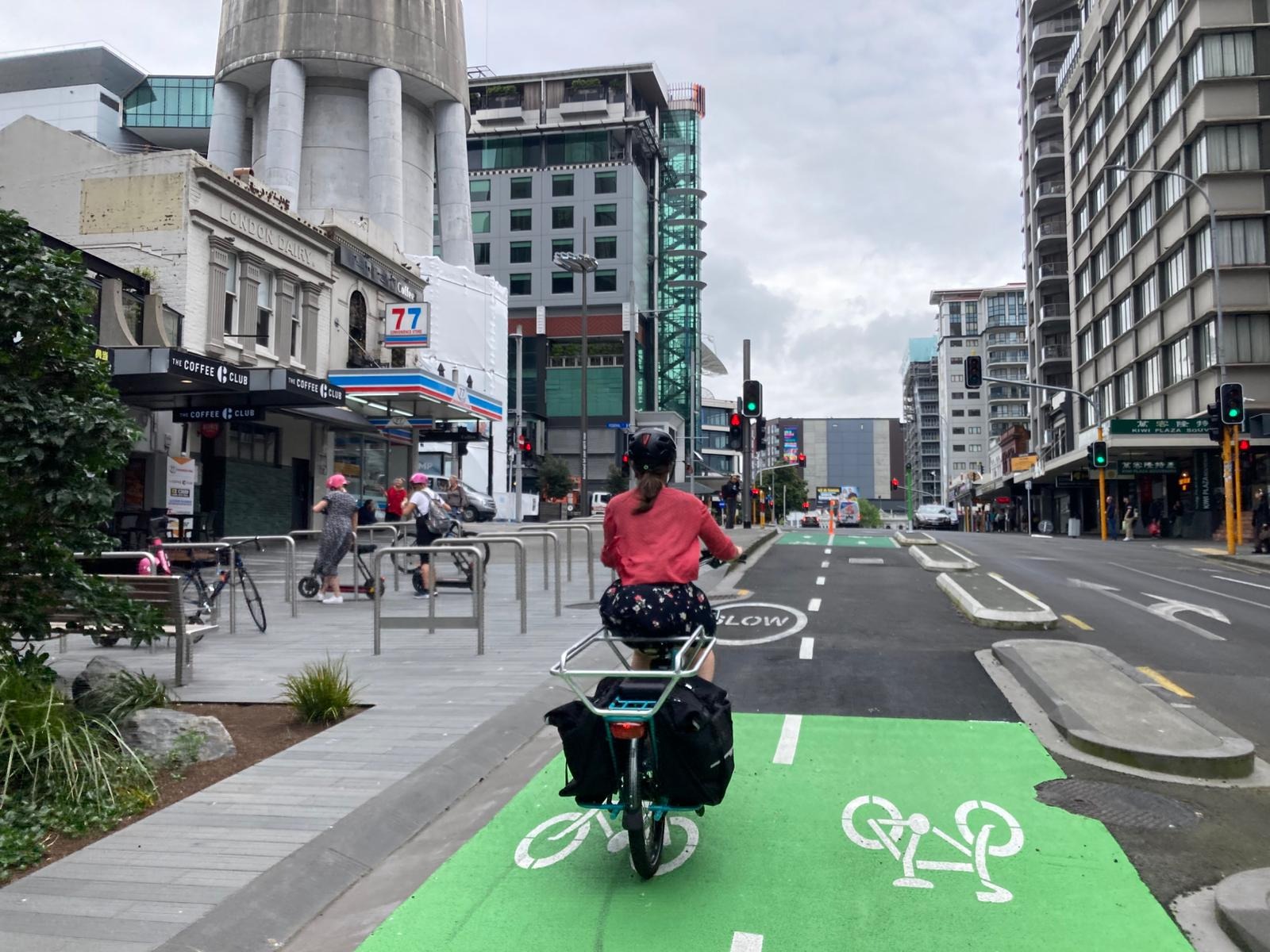
Their new e-bike lending scheme is right up my street – or right up my cycleway, more to the point! And their e-bike fleet has the perfect bike for me AND my daughter. It’s an Ezee Expedir e-cargo bike, big enough to carry a family. In a beautiful teal colour, it looks gorgeous too.

Trying the e-cargo bike: a different riding experience
Anna from Gribblehirst Community Hub kindly took me through the features of the bike, how to charge the battery, how to use the key to start it and secure it when parked, how to use the dual-leg kick stand, how to turn the built in lights on and off, how to change gears and power settings and use the throttle.
It’s quite different to other e-bikes I’ve tried. Even leaving aside the extra length, the riding experience is poles apart. That’s because this bike is built like an ox! It can carry huge loads, and that means it benefits from a throttle. The throttle is a power boost lever that drives the front wheel to get you started even before you move the pedals. It’s handy for hill starts. It’s also handy if you want to walk the bike uphill – something that would be really tricky unpowered, because the bike weighs around 35kg.
Having a throttle means another difference too – it’s a lot more common to have a throttle on a hub-drive bike. I’d previously ridden on mid-drive e-bikes – and it’s just different. My non-technical description of the difference is this. Mid-drive means the power assist is added in the middle of the bike, at the pedals. Push on the pedals and the motor adds power. Hub-drive means the power is added at the hub of either the front or rear wheel. For me this meant that I was continuing to be boosted along after I’d stopped pedalling – because the wheel was still turning. Disconcerting, until you get used to it.
The best description I’ve read of the riding experience is this: “Front [hub] feels like something is pulling you, rear [hub] feels like someone is pushing you. Mid gives the best kind of ‘natural’ feeling.”
That’s not to say I’d rule out a hub-drive e-bike in future – there are definite advantages for the way I plan to use my future dream bike. But I am very glad to be able to choose based on a decent amount of testing it out. Thanks e-bike lending scheme!

Keeping the e-cargo bike safe
A new e-cargo bike is worth around $4k-$10k. The Expedir appears to sell for around $5k, not including accessories like the wonderful bench seat, the front rack, and the roomy panniers. Being trusted with this lovely brand new e-cargo bike, I was determined to keep it safe.
Bike theft is becoming more common around Auckland, especially places like the city centre. Auckland Transport are looking at options for secure bike parking, and there are more Locky Docks appearing all the time (I’m a big fan of how easy and safe these are). But for my excursions on the Expedir, I needed to carry my own solution.
Luckily, it has some good features to help. It comes with a ‘cafe lock’ – a bar that goes through the spokes of the back wheel to stop someone opportunistically riding off on the bike. And more importantly, it doesn’t start without the key being in the ignition. Keeping the key on my person feels like an added layer of protection. And I don’t have to worry about the lights being stolen off the bike either, because they’re hard-wired in!
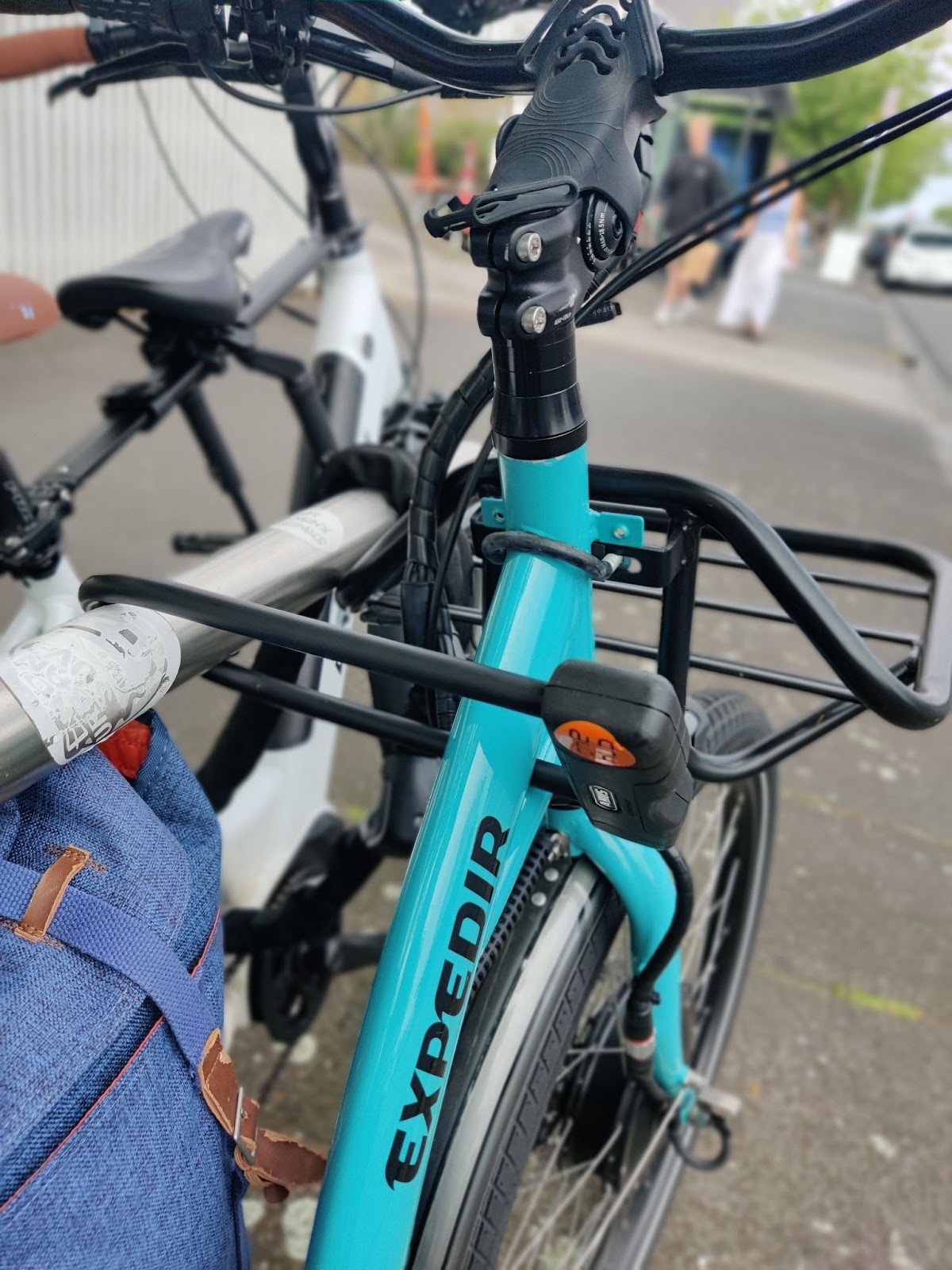
Gribblehirst Hub provided a D-Lock with the bike. D-Locks are one of the most secure locks out there, but I didn’t think it was a perfect solution for the Expedir. The bike is pretty wide, especially with its front rack and the cage protecting the bench seat on the back. Not every bike stand would allow me to get the bike frame close enough to use the D-Lock. I brought my own heavy chain along too, in case I couldn’t manage the D-Lock, and I’d recommend this approach as more flexible with this style of bike.
All of this helped reassure me that if I owned an e-cargo bike, there were ways to keep it secure without compromising on the places I wanted to park up.
First outings
Eager to start cycling, I envisioned many enjoyable trips with my five-year-old on the e-cargo bike. However, my inaugural ride was a 3 km journey to a food history tour in Ponsonby, not with my daughter. This proved beneficial, allowing me to get used to the bike’s handling independently before introducing the added dynamic of a child to the ride.
It proved to be a great way to get to the history tour – and I was able to tell other people that they too could try out an e-bike from an e-bike library or lending scheme. People’s eyes really light up at this idea – it is such an important purchase and the library offering strikes a chord.
Carrying my kid on the e-cargo bike
The next day, Sunday, it was time for five-year-old Sophie to have her turn. The three of us made a plan to cycle to Diwali on Queen Street, where we could leave our precious e-bikes with the Bike Valet. My wife would be there as backup to carry Sophie on her bike if it didn’t work out.
I was excited. Sophie easily got on the bike, which, despite wobbling on its kickstand, withstood the carefree clambering. (Getting off around the cage remains a challenge.)

The bike has footrests that look like little running boards alongside the bench seat. But with panniers in place, you can’t access them. I still needed a pannier to carry the locks and other baggage like raincoats, so we compromised on one pannier and one footrest. Sophie would prefer two footrests, but it worked well enough. Potentially a better long term set up would be closed storage on the front of the bike, or even smaller panniers could work.
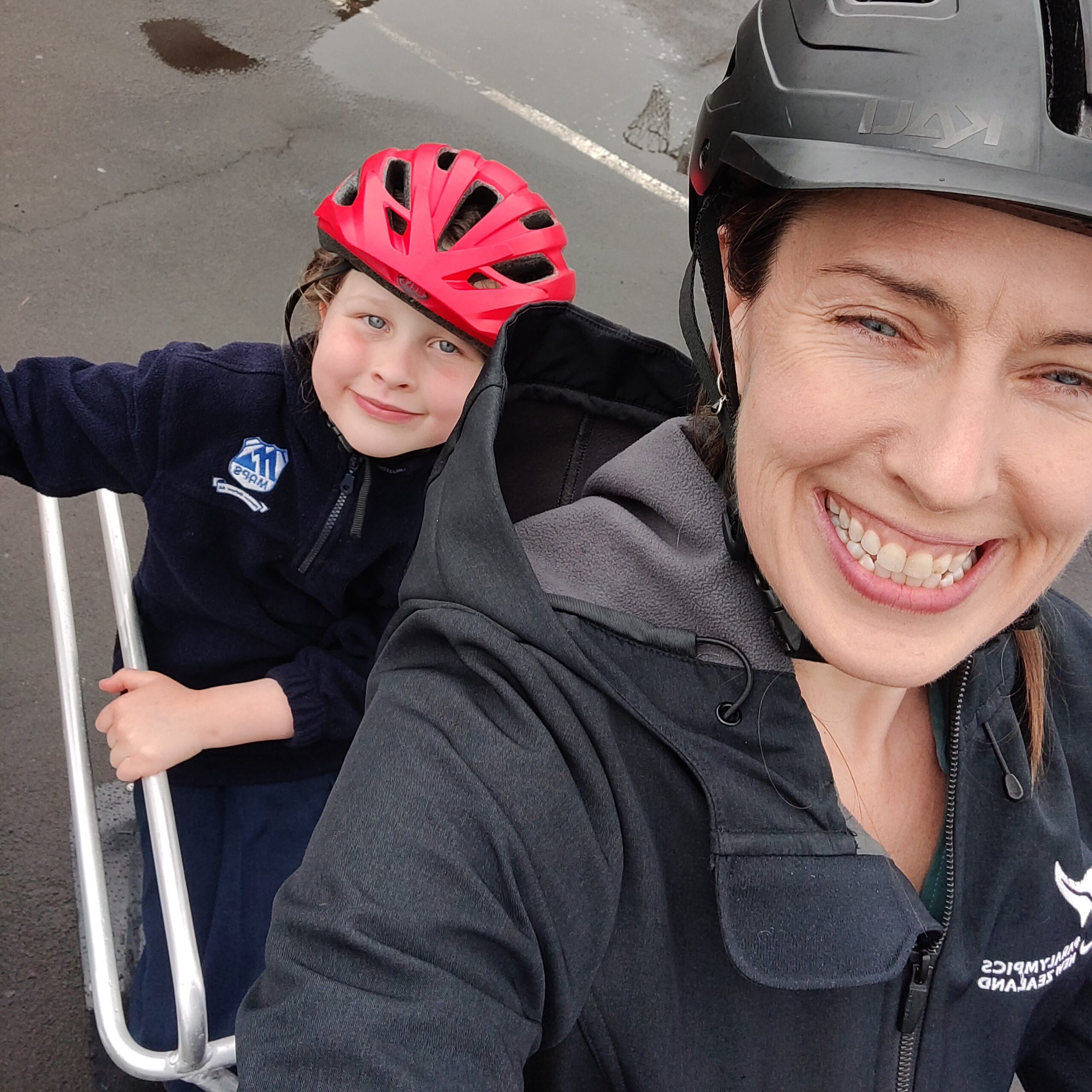
Off we set along the Northwestern Shared Path. The experience of a substantial moving weight on the back of your bike is unnerving! My dream of smoothly sailing through town with my junior cargo was, in reality, quite scary. There was a lot of “Don’t move! No, you can not turn around while the bike is moving!” It was new for both of us, and Sophie had to find her way with it too.
Over the two weeks of the hire, that feeling has become easier. There are still tricky moments where I beg Sophie to “sit still!” but for the most part, we’ve found our balance. I can see it becoming second nature over a longer period.
Unlike my experience with towing Sophie in a bike trailer (disastrous), this has been much more to her liking.
Diwali was great fun, especially with the reassurance of knowing the bike was safe with the Bike Valet. The pannier was more than big enough to carry home some delicious Indian kai!
Definitely a good test for me of how an e-cargo bike would work in my life.
I used the e-cargo bike every day of the loan
I found myself getting out and about by bike every day that I had the Expedir – much more than I do with my push bike.
- Monday – dinner in Mt Eden. It felt great to rock up by bike.
- Tuesday – a work meeting in Ponsonby Central. Even in the pouring rain it was fun to arrive by bike. The Locky Docks now right outside Ponsonsby Central gave me added reassurance that the bike would be safe. Locky Docks may not fit around all e-cargo bike frame shapes, but it was possible with the Expedir.
- Wednesday – I quickly grabbed the last available bike rack outside the Ellen Melville Centre, a common occurrence when attending a workshop for climate-conscious individuals – everyone cycles there! It was particularly fitting that our session focused on encouraging car drivers to share the road with people on bikes.
- Thursday – as well as a meeting in town, and taking Sophie Halloween costume shopping by bike, I was able to roll up in style to the Biketober Climate Fresk. All the other participants came by bike too, which felt really special.
- Friday – I got ambitious. The Waterview Community & Envirohub were running a Biketober Cycle Safety Trail event after school. Could I carry Sophie and her bike the 4 km to Waterview Reserve? Some bungee cords later, and a super wide load, and we were off. It’s not an experience I’d want to repeat every day, but it worked. Kiddo and bike were safely transported to and from the excellent event.
- Saturday – it was the perfect spring day to carry Sophie on the bike for lunch out with her uncle.
- Sunday – my opportunity to quax! I got a weekly shop entirely by bike and it was even more fun than I expected. 10 out of 10.
- Monday – the bike made the school run a breeze. It’s usually literally a run. This was a welcome break.
- Tuesday – more meetings in town, by bike.
- Wednesday – my busiest day of biking yet. I was presenting about bike events at the Community Climate Action Network Hui in Grey Lynn – a natural opportunity to bike. I loaded up with cat food at Pet Stock on the way back (a hill I’d likely have skipped on my pedal bike). Then I whizzed past the other parents in their huge cars to do the school run. Later, the whole family biked to the Biketober tour of Karanga-a-Hape Station – so much easier than driving, even on a wet evening.
- Thursday – the teacher and nurse strike. Sophie wanted to go by train, and I was happy to cycle up the hill with her to the station (a feat I can’t manage with muscle power alone) and put the bike on the train into town. The great thing about this was that we could enjoy the novelty of the train one way, and then speed off home whenever we wanted on the bike.
- Friday – a last bike outing to a local cafe for a meeting, before we were off, by car, to Muriwai to camp for the long weekend. I felt a surprising twinge of sadness at missing out on e-biking.
By the end of the hire, I had a definite attachment to the e-bike. I didn’t want to give it back.
For me, it has firmed up my thinking – I definitely want the e-cargo bike life. Following this trial, I feel much better informed about what that will be like, and choosing the right bike for us.
Why I love that Gribblehirst Hub is doing e-bike loans
E-bikes offer a solution to many of the barriers to getting around actively – it’s easier to get started, no route is too hilly, you can carry more stuff, you can wear just about any kind of clothes, and you don’t arrive sweaty (if you don’t want to!). They are a mobility aid for disabled people.
But, they are a significant and often bewildering purchase. E-bike lending schemes or libraries offer a powerful way to make cycling more accessible, equitable, and appealing. By allowing people to borrow e-bikes for free, they give users a chance to experience the convenience and joy of e-biking firsthand. They support climate-friendly transport, reduce car dependency, and foster healthier communities. These schemes also help shift public perceptions – showing that cycling can be practical, inclusive, and fun for people of all ages, abilities, and lifestyles.
How to access Gribblehirst’s e-bike loans and other e-bike libraries
Gribblehirst Community Hub’s e-bike loans are available to their members. The Hub is in Sandringham and you can sign up to join on their website. There is no cost to loan a bike (a deposit is paid and returned when the bike is returned).
If you’re in other parts of Auckland, Ecomatters Go Ebike Loans may be a more convenient e-bike library for you.