
Auckland Transport will close 21 Western Line Level Crossings, or replace them with something different
The City Rail Link (CRL) will transform Auckland’s transport network, and we can’t wait. Bikes and trains are a great combo for getting most places you want to go.
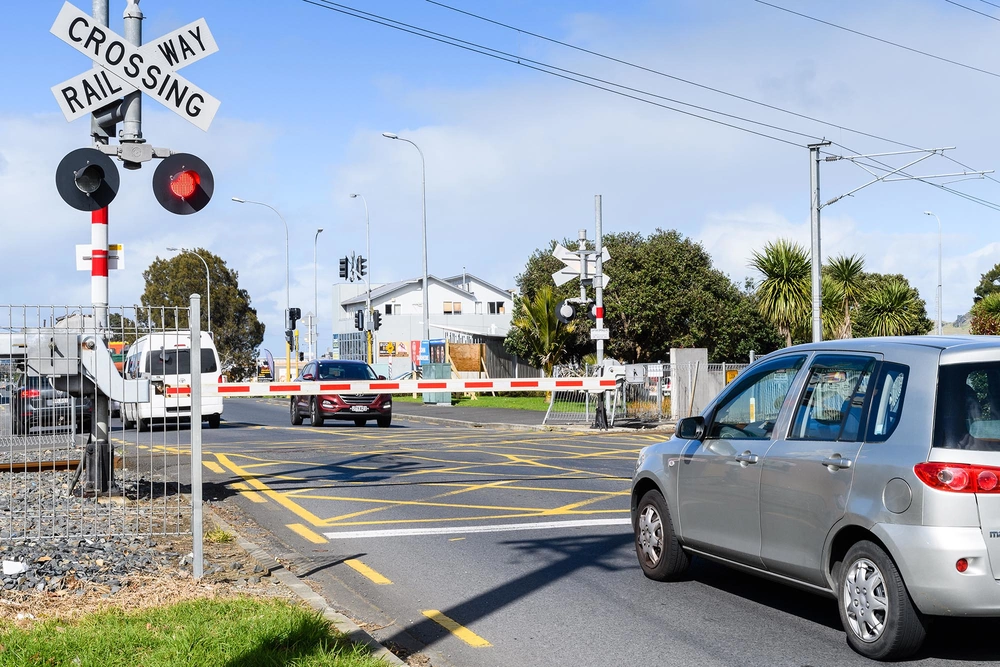
But CRL also brings a major change for those of us riding bikes: the removal or replacement of 21 level crossings along the Western Line. When the project is complete, there will be no more level crossings – neither road nor walk-and-bike – in the Auckland region.
With trains running much more frequently, level crossings aren’t practical.
The 21 crossings include every level crossing from Kingsland to Swanson. They will change in two stages:
- Inner West from Maungawhau to Mt Albert – replacements and removals begin in the early 2030s.
- West from Mt Albert to Swanson – replacements and removals begin in the late 2030s.
What will AT replace the level crossings with?
Auckland Transport haven’t yet proposed a solution for each crossing – they want to hear from those using the routes first. But they have shared the main options. I’ve listed them here in order from cheapest to costliest.
1. Close the crossing completely
Close the level crossing. An alternative route replaces access.
2. A walk-and-wheel bridge or underpass
“A walking and cycling bridge or underpass that people on foot, bike, or using mobility aids can use, but not vehicles.”
3. Maintain road access – two variants
3a. A road bridge or underpass
“A road bridge or underpass that goes over or under the train tracks, allowing vehicles as well as people walking, cycling, or using mobility aids to cross safely.”
“A road bridge or underpass in a different location to the current level crossing.”
3b. A rail trench or rail bridge
“A rail trench at a lower level to the surrounding area, allowing a road, footpath and cycle route above rail lines – similar to New Lynn. The gradients required for rail mean this would be long and likely have a high cost.”
“Rail lines on a long bridge allowing trains above roads, footpaths and the surrounding area. Like a rail trench, the gradients required mean this would be long and likely have a high cost.”
What isn’t an option
Auckland Transport has been clear that all crossings are being removed or replaced. Keeping a level crossing, even just for people on foot or on bike, is not an option.
Why people who bike need to speak up now

When travelling on the road and cycleway network, rail lines are essentially walls that you can only cross at specific points. If AT closes a crossing without a high-quality replacement, it could add kilometres to your travel and/or force you onto suboptimal routes for bikes.
Auckland Transport (AT) would like to hear from the community about how they use the level crossing routes before they put forward proposed designs. You have until 31 May to Have Your Say.
Here are some questions that we’ve been thinking about:
- Detours. If a crossing were closed today, how far away is the next nearest place to cross? Is it critical for the community that walking and cycling access remains open here? What key destinations, like schools, homes and shops, does the crossing access?
- Accessibility. If the crossing is replaced by a bridge or underpass, is the gradient likely to be difficult for someone on a pedal bike or in a wheelchair? Do we need to argue for lifts which are big enough for all bikes and mobility aids?
- People-first design. What are the priorities for the surrounding community for the replacement? Does it need to be utilitarian and focus on ease of passing through, or should we also be asking for attractive, well-lit streetscapes where people enjoy spending time?
- Low-traffic neighbourhoods. Would this area benefit from removing through-traffic? Could a low-traffic neighbourhood provide a vibrant future for this area? (Find out what low-traffic neighbourhoods are on Greater Auckland.) Could a walking-and-cycling bridge or underpass act as a ‘modal filter’ to keep streets enjoyable for all? AT are looking for “urban development opportunities” – or places which are ripe for redevelopment, as they consider which option is right for each crossing.
How to Have Your Say
There are several options for giving your input. You can fill in the online form, talk to AT at a drop-in session, or email AT: LevelCrossings@at.govt.nz.
When you fill out the Online Form, you can choose to give general feedback or comment on specific crossings. Specific feedback can be more powerful.
Key Details to Remember
- Deadline: Submissions close 31 May.
- The form: Use the AT Western Line Survey Link. You may want to refer to the information on AT’s webpage about this programme of work.
- Drop-in Sessions: AT is hosting physical sessions along the line. If you have a complex local crossing, go talk to them in person! (Check the AT webpage and click “Show feedback options” for specific dates and locations near you).
You don’t have to be a city planner to have an opinion. If you ride through these areas, you are the expert on how these crossings function. Tell your story!
Have your say by 31 May!
Bike Auckland would love to hear your thoughts too. What are the specific considerations at your local level crossing? Would you like to see the area become a vibrant low traffic neighbourhood? Please share your specific needs, ideas, or concerns as we advocate for a more connected region: communications@bikeauckland.org.nz.