
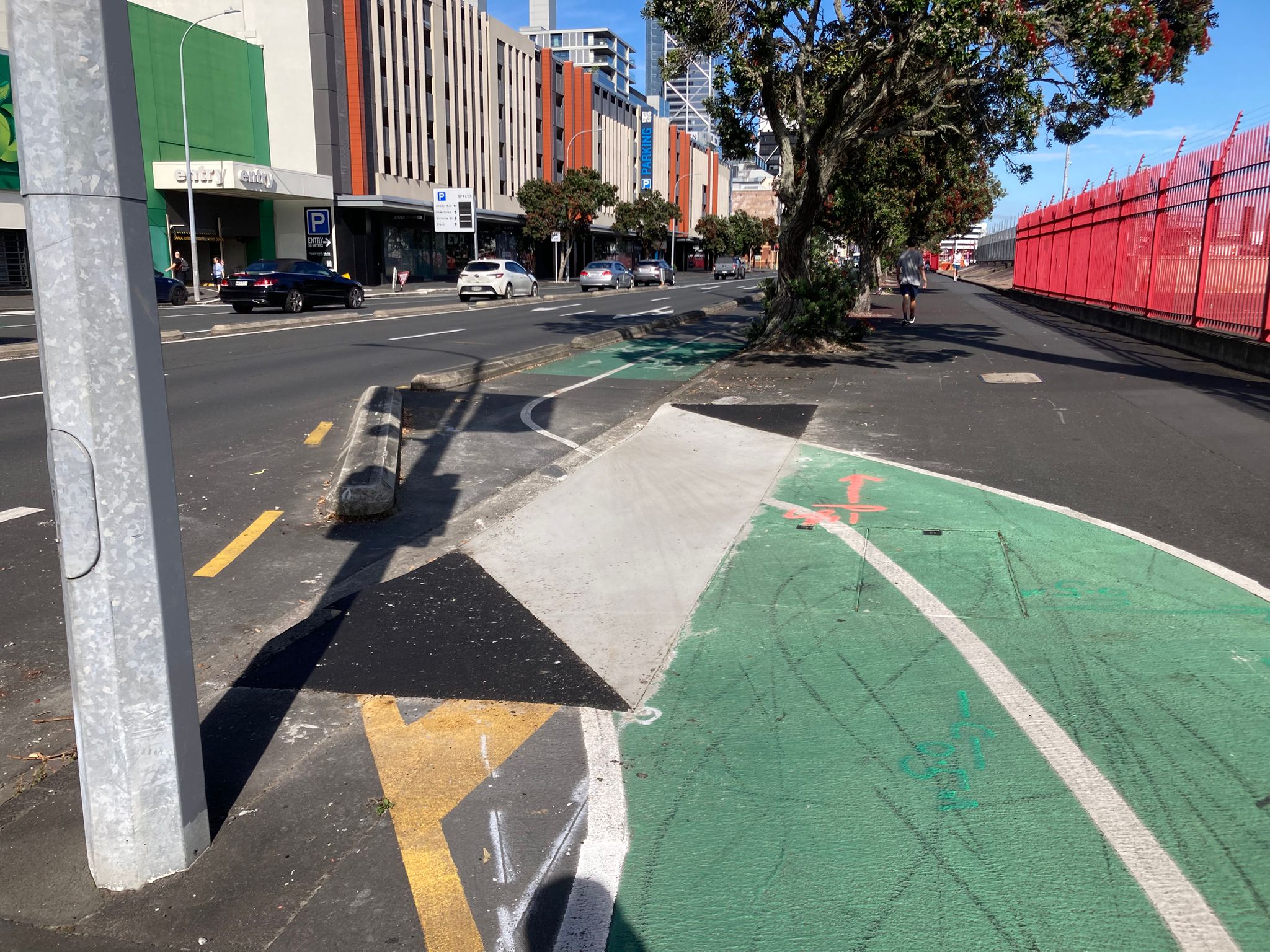
A tricky ramp on the Quay St cycleway was causing some kinds of bikes to tip, thanks to its camber and sharp corner. The adaptive bikes which disabled riders use were particularly vulnerable to the hazard. Bike Auckland’s landmark Inclusive Cycling Report put the hazard onto Auckland Transport’s radar, and dedicated follow-up got it fixed.
A well-known danger spot
In 2023, Bike Auckland published Tāmaki Makaurau’s first Inclusive Cycling Report. This landmark audit assessed the accessibility of 50 kilometres of Auckland paths. For those with a disability, a bike can be a crucial mobility aid to enable access to the outside world. But we were well aware that not all cycleways were created to be accessible to all.


One of the hazards we identified in the report was a kerb cut on Quay Street in the city centre. It was a danger spot that the auditors and Bike Auckland already knew well. The ramp where the cycleway moves from the road to the footpath has a sideways camber, and requires a sharp turn. This combination can be dangerous for some bike types, causing them to tip. Indeed, this is what had happened to auditors Kimberly Graham and her son in their wheelchair bike. Luckily, they were uninjured.
Love what we do? Join Bike Auckland today and make a difference for Tāmaki Makaurau Auckland’s cycle network!
Including the issue in the Inclusive Cycling Report elevated it into the forums where it needed to be heard. Due to other constraints, it wasn’t a simple fix, and AT put road markings to highlight the hazard while they worked on a more permanent solution. They aligned the fix with another roading project, making it an efficient use of budget. Bike Auckland continued to ask about a permanent solution, and AT diligently followed up.
We’re happy that everyone can now use the Quay Street kerb cut.
Kimberly Graham of Grab Your Wheels, Let’s Travel, says:
“This is a really positive outcome. I’m grateful to Bike Auckland and Auckland Transport for listening and acting. Small pieces of infrastructure can have big consequences, and addressing this kerb cut will make Quay Street safer for people using cycles, mobility devices, and non-standard bikes.”
What does the Tāmaki Makaurau Auckland Inclusive Cycling Report include?
Commissioned by Bike Auckland and under the lead of Grab Your Wheels, Let’s Travel, a team of epic auditors created a snapshot of the current state of our cycleways. Auditors were disabled people or had a disabled dependent on board their bike (e.g., in a bike trailer). The report includes what needs to change to make the cycleways more inclusive.
Why is cycleway accessibility important?
Disabled people have the right to participate fully in all aspects of life. That means the design of our transport systems needs to support disabled people to participate fully. Transport plays a key role in enabling people to hang out, work, and join activities.
For some people riding a bike is easier and less painful than walking. For them, a bike is a vital mobility aid. But there are still many barriers to cycling for our disabled community. For instance, some disabled people require adapted bikes in order to be able to cycle. Adaptive bikes are sometimes wider, or longer than a ‘standard’ two-wheeled bike, so they have different cycleway design requirements. Yet transport planners usually design our cycleways with two wheeled bikes and able-bodied people in mind.
Since 2023, Bike Auckland has worked hard on reducing barriers to cycling for people with disabilities. As well as the audit and report, Bike Auckland’s work helps disabled individuals find a bike that works for them. Bike Auckland advocates to make sure accessibility is a front-and-centre design consideration when transport agencies create or modify cycleways.
What is a non-standard bike for disabled people?
Non‑standard bikes open the door to cycling for people with a huge range of abilities, needs and preferences. There’s a solution for almost every body and every situation. Here are some examples:
- Tricycles reduce the need to balance.
- Tandems support riders with visual impairments.
- Adult or child tag‑alongs allow partnered riding.
- Handcycles can be upright, recumbent or wheelchair‑clip‑on. They give people with limited or no lower‑body mobility the freedom to ride using arm power.
- Recumbent cycles offer comfort and a lower centre of gravity for anyone who struggles with traditional bike posture.
As well as specially-designed bikes, simple modifications like single‑hand controls, a dropper seatpost, and swing cranks can make a standard bike easier to use for a disabled person.
The cycling world is full of clever ways to reconfigure wheels, pedals and seating so that almost anyone can experience the joy and independence of riding.


What is accessible cycling infrastructure?
Barriers to cycling for disabled people can be diverse – from the cost of a bike to the design of the street. Here we give a few examples of the barriers we identified in the audit.
Some of our protected cycleways are too narrow. Physical things on the road space, such as drains and road works signs, can make the cycleways even narrower, sometimes making them completely inaccessible. Gutters can cause uneven surfaces, which can create a barrier, even tipping some bike styles. Bollards and other physical barriers which keep cars and motorbikes off paths can also keep adaptive bikes off them if they are too close together.
Keep reading: check out our article on physical barriers to inclusive cycling.